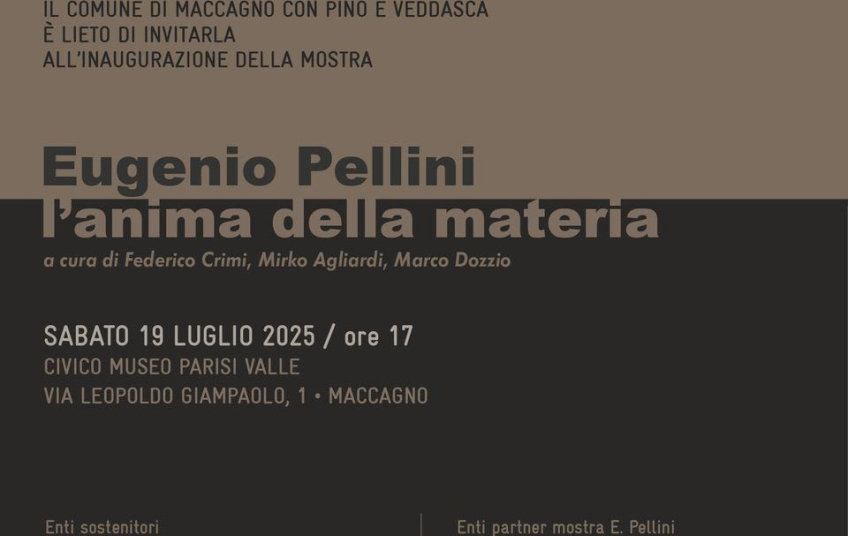
Eugenio Pellini, the soul of matter
curated by Federico Crimi, Mirko Agliardi, Marco Dozzio
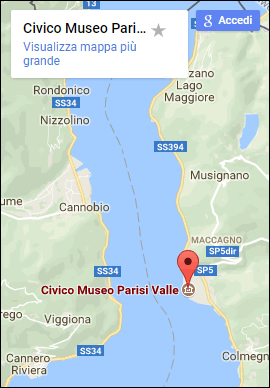
Civico Museo Parisi Valle
Saturday, July 19, 2025, 5:00 pm
Inauguration of the exhibition and the new MuMa space
EUGENIO PELLINI: GESTURE AND SUBSTANCE
A reserved artist yet deeply rooted in the Lombard scene between the 19th and early 20th centuries, Eugenio Pellini is known for his ability to give form to matter through lyrical and introspective sculpture, which escapes academic stylistic devices to seek the human and spiritual essence of his subjects. His works, in bronze, marble, and plaster, express a silent intimacy that the Parisi Valle exhibition will fully convey, with a significant selection of works from public and private collections.
The proposed itinerary, in fact, takes advantage of the availability and important loans from Atelier Pellini, Milan, the Gipsoteca Bozzolo-Pellini in Marchirolo (Varese), and private collections, extending the gaze beyond the local borders thanks to the concrete collaboration with the Fondazione Cardinale Giacomo Lercaro in Bologna, whose collections of ancient, modern, and contemporary art contain the most important body of Eugenio Pellini's works outside of Lombardy.
A NEW SPACE FOR THE MUSEUM AND THE COMMUNITY: THE BIRTH OF MuMa
During the event, the public will be able to attend the inauguration of the new Bookshop, a completely renovated space that will also house a tourist information point to promote the area. The new space will be called MuMa, a reference point not only for museum visitors but also for those who wish to discover the cultural, naturalistic, and historical offerings of the Municipality and Lake Maggiore.
The new MuMa space was strongly supported by Mayor Ivan Vargiu and Councilor Andrea Sbernini, as part of a broader vision of cultural revitalization for Maccagno and its surrounding area.
A MUSEUM THAT LOOKS TO THE FUTURE, WITH STRONG ROOTS
The initiative is part of the Municipal Administration's broader project, which has undertaken a determined path to revitalize and enhance the Parisi Valle Civic Museum, recognizing its central role in the cultural life of the area. Particular attention is paid to the Parisi Valle Collection, the original heart of the museum institution, whose historical and artistic importance will be the subject of a rediscovery and exhibition reorganization plan in the coming months.
Exhibition Guide
The exhibition offers a journey through the works and life of Eugenio Pellini (1864-1934), one of the most sensitive sculptors of his time in terms of expressive power, technical mastery, experimentation and content.
Pellini was born in Marchirolo, a small town in the province of Varese, between Luino and Lake Lugano. He inherited the rich sculptural tradition of Varese artists like Odoardo Tabacchi and Giuseppe Grandi; yet Pellini made his fortune in Milan. Here, he founded his studio, which he would later pass on to his son Eros (Milan, 1909-1993). It still reflects a vocation for the art of sculpture that has lasted for generations, for almost a century. Today, this hidden place in the heart of the Lombard capital is known as Atelier Pellini, from which comes a large number of works on display. Others originate from the Bozzolo-Pellini plaster collection in his native Marchirolo. The town’s graveyard is richly adorned with statues by father and son and seems to be a Monumental Cemetery in miniature. The remaining works are on loan from private collectors.
Rossana Bossaglia, one of Italy’s most prominent art critics, describes Pellini as ‘an artist who could compete with the best sculptors of his time’. According to Elena Pontiggia, who curated a Pellini exhibition at Milan’s Permanente in 2003, Pellinis story was even ‘a love story’: love for sculpture intended as the most valid artistic approach ‘to humanity, to life, human experience and emotions’.
These words provide the best introduction to the heart of Eugenio Pellini's emotional universe. Appreciated by his contemporaries for his small ‘bronze sculptures, with representations of gentle intimacy’ (Bossaglia), namely female portraits, mothers with babies in their arms, children in play and young girls, Pellini offers a poetical repertoire of great intimacy that unfolds before the visitors’ eyes. The artist tends to prefer small formats even when treating themes of strong social commitment as in Spazzacamino (Chimneysweep, 1888), a protest against child labour. The artist focuses with pity on the head of a child asleep under the Arch of Peace in Milan, bowed with fatigue. The bronze sculpture of a Garibaldi-monument (1901) depicts the hero as the Good Shepherd holding a lamb in his arms. Even a plaster sketch of Giuseppe Verdi (1910-11), submitted to the public competition for the monument in Milan, is executed in a simple, familiar stile. Most part of the funerary sculpture is treated in the same, only apparently less significant way.
In his repertoire, the artist’s life and art are deeply intertwined. His wife was the model for the maternal figures, and also his children often appear as subjects in his work. Nevertheless, Pellini managed to express and create ‘great things’ (Bossaglia).
Within this personal universe of favourite themes, the sculptor experimented with forms continuously, working on variations of few subjects. He was inspired by different currents - first Scapigliatura, later Italian Verismo and Art Nouveau - and artists like Medardo Rosso and Rodin. Finally, Pellini himself came to influence the evolution of artistic taste and style.
Coherently, this exhibition closes with the bust of Christ in Gethsemane (1891-94), which is a fragment of a monumental standing Christ gazing into the darkness of the evening, full of pain for recent betrayal. The statue was cast for various burial places. It rightly is Pellini's most famous creation, and probably the first statue executed in the style of Italian Symbolism even before Leonardo Bistolfi.
Pellini embarked on his innovative journey into the symbolist universe ‘with a formal intelligence and delicacy of execution that place him among the leading exponents of Art Nouveau sculpture’ (Bossaglia). This is also testified by the intense funerary sculptures for the Monumental Cemetery in Milan, represented here by the plaster sketch of L'Angelo del dolore (The Angel of Pain) for the Baj Macario tomb (1904).
The exhibition opens with the already mentioned Spazzacamino (Chimneysweep, 1888) featuring a previously unseen bronze cast and the original plaster model. This arrangement is repeated with Return from the mountain (1888): the bronze, with its golden-toned patina, contrasts the plaster shaped by the artist. These are two of the most poetical sculptures of the nineteenth century, not only in Lombardy. The gestures, the elegance, the delicacy and the empathy with which Pellini treated his subjects are the best introduction to his oeuvre.
Works on Display and Biography
In the catalogue for the 2003 exhibition at the Triennale of Milan, Elena Pontiggia describes the different stylistic periods of Eugenio Pellini: his first steps in the tradition of the Scapigliatura movement, his encounter with the work of Medardo Rosso and – after his trip to Paris – of Rodin and his disciples, the influence of Italian verismo and, finally, of symbolism and the purest forms of Art Nouveau. Throughout his career, the sculptor remained interested in social questions. After the encounter with his wife and the birth of his children, though, his repertoire focused on domestic scenes with an idyllic tone.
The thirty works on display in this exhibition provide a comprehensive overview of the stylistic periods, concerns and contents of Eugenio Pellini's work and some of the biographical events of his life.
Eugenio Pellini was born in Marchirolo on November 17, 1864, to Carolina and Andrea Pellini. He attended elementary school until the fourth grade and in 1878 moved to Milan, where he lived at the house of his brother Oreste and worked as an apprentice in the studio of sculptor Filippo Biganzoli.
The exhibition shows several early works, which were influenced by the Milanese Scapigliatura movement: Sull’erba (On the Grass, 1884, bronze), Ritorno dalla montagna (Return from the Mountain, 1888, bronze and plaster) and Sotto l’Arco della Pace (Under the Arch of Peace, 1888, bronze and plaster).The latter is particularly significant for the socialist ideas that inspired him from the beginning. The young sculptor managed to capture ‘the fatigue of an exhausted young chimney sweep, combining social protest and an introspective approach in a solution similar to the contemporary works of Medardo Rosso’ (Franco).
In 1884, he enrolled at the Brera Academy and was admitted to the sculpture school directed by Ambrogio Borghi, where he received medals and awards. Fruit of this training was Fanciullo di Nazareth (or Monello, 1891), a work that alludes at the identity of the son of the people and the son of God. The exhibition presents a bronze cast dating back to the 1920s and based on the original sketch for the bust (Milan, Atelier Pellini). In background, the complete work is on display in a giant reproduction of a vintage photo.
In 1891, Pellini obtained the Pietro Oggioni triennial prize, which included a grant for the Academy of Fine Arts in Rome. In the same year, he travelled to Florence, Rome and Sicily, where he participated in the 1892 National Exhibition in Palermo with La piscinina (bronze, location unknown), a sculpture focusing once again on the theme of child labour. In 1892, he went on a trip to Paris to study the works of Auguste Rodin.
In 1893, he participated in the XLI Promotrice in Genoa with a bronze head, Stanca, which was later presented at the I Triennale in Turin in 1896.
In 1894, he won the competition for the War Memorial in Domodossola (bronze) and obtained his first important private commission for the Monumental Cemetery of Milan: the standing figure of Christ in Gethsemane (1895-1906, Lardera tomb). This work aroused controversy with Leonardo Bistolfi, who had created a similar work (Christ Walking on Water,1899, plaster) for the Monumental Cemetery in Casale Monferrato. The bronze bust on display here is accompanied by a study (First idea for Christ in Gethsemane; Marchirolo, plaster cast collection) which significantly dates the invention back to 1891.
In these years, the artist went through ‘the evolution of his realistic language into a symbolist stile, interpreted rather in intimate than grandiose forms’ (Franco). This is testified by the sketch he presented in 1895 at the competition for the Monument to the Cairoli Brothers in Pavia (Pavia, Musei Civici). It can also be observed in works with a solid composition such as Mother (1897, plaster, Milan, Galleria d’arte moderna), which earned him the Antonio Tantardini Prize in 1897, as well as the prizes at the Universal Exposition in Paris in 1900 and the 5th Exposición internacional de arte in Barcelona in 1907.
During the anti-socialist repressions in Milan, from 1898 to 1900 he took refuge in Varese, where he taught at the School of Applied Arts. In 1900, he returned to Milan and worked as a teacher at the School of Artisans at Castello Sforzesco. Here, in 1903, he met Dina Magnani, a model at the Brera Academy. They married shortly after and Dina lent her face to the second version of Mother (1903, Marchirolo, Plaster cast collection). The couple had three children: Nives (b.1905), Eros (b. 1909), and Silvana (b. 1911), who became the favorite subjects of Eugenio’s works. Dina Magnani appears several times in this exhibition: in the bronze portrait of a seated figure (Portrait of the Artist’s Wife) completed between 1903 and 1915, and as a model for the captivating plaster sculpture Morning Kiss (before 1914), chosen as the symbol of the exhibition. She was also the model for the plaster sculpture Mother with Child on display in the second room. Here, among a group of beloved, features the bronze Racconti della nonna (Grandmother's Stories, circa 1910), evoking memories of his childhood in Marchirolo. The sculpture is one of Eugenio Pellini's most intense works in shape and expression.
In 1905, he was among the artists selected to represent the Lombard school at the International Art Exhibition in Munich (Head of an Adolescent, bronze, Milan, Atelier Pellini). In the same year, he participated in the 6th Venice Biennale with Vox clamantis in deserto (Voice in the Desert, marble, Milan, Atelier Pellini). Also dating back to 1905 are the two Telamons for the balcony of the Bianchi house in Varese designed by Giulio Macchi. The nudes, bowed under their heavy load, recall the mastery of Rodin in his Michelangelo-inspired period; a mastery that can also be found in Giuda (Marchirolo, Gipsoteca) and Minatore (Miner, bronze, Milan, Atelier Pellini), both from 1906. Minatore was presented for the first time at the National Fine Arts Exhibition in Milan and has been rarely exposed since then.
L'idolo (The Idol), one of Pellini’s most significant and well-known works, was also completed in 1906. The marble sculpture is preserved in Bologna, at the Fondazione Cardinale Giacomo Lercaro. The work, which won the gold medal from the Ministry of Education, was presented in 1907 at the 7th Venice Biennale and, in 1909, at the 1st National Exhibition of Fine Arts in Rimini (bronze, Milan, private collection). Pellini also sent La notte di Caprera (Garibaldi) to the latter event, depicting the hero of two worlds as the Good Shepherd.
The concise stile of this work was followed by the well-balanced composition of Cassandra (or Portrait of the Artist’s Wife, 1906, marble, Milan, Atelier Pellini), exhibited at the 8th Venice Biennale (1909), which anticipated the ‘broad approach’ (Franco) of the portrait of Karl Marx (1913).
Before the Great War, Pellini did not win any of the public competitions he took part in: neither the 1910 tender for the Monument to the Thousand in Quarto, Genoa, nor those launched by the Municipality of Milan for the Monument to Giuseppe Verdi in Piazza Buonarroti (1910-11), where he reached the 2nd place, nor for the bronze side doors of the cathedral, on which he published two articles in Arte e artisti (Dec. 16, 1908, and Feb. 16, 1916).
In the meantime, his recognition among critics and private collectors grew constantly.
In 1910, Vittorio Pica published an image of the standing figure Come Narciso (Like Narcissus) in Emporium (no. 189, p. 212) in his review of the 9th Venice Biennale. On March 15, 1911, Pellini’s friend, architect Alfredo Melani dedicated an article to him in Varietas, which he titled Uno scultore della maternità e dell’infanzia (A sculptor of motherhood and childhood).
Meanwhile, the controversy with Leonardo Bistolfi was nourished by the bas-reliefs created by Pellini in 1910 for the Merli Maggi chapel in Milan's Monumental Cemetery. The chapel had been designed and presented in L'Architettura italiana in 1910 by Melani, who made modernist ideas popular in Italy. Pellini, grateful for his friendship and esteem, dedicated a bronze portrait to Melani, now preserved in the Civico Museo in Pistoia.
Already present at the International Fine Arts Exhibition in Buenos Aires in 1910, Eugenio Pellini was among the artists selected to represent Italy at the Panama-Pacific International Exposition in San Francisco in 1915.
At that time, Pellini had become one of the most appreciated sculptors of funerary art and portrait busts among wealthy Italian clients. Only for the Monumental Cemetery in Milan he created forty-six works, including The Angel of Sorrow, 1904, in Carrara marble with bronze decorations, Baj-Macario tomb). He also produced statues for the cemeteries of Varese, Gallarate, Giubiano, Vigevano, Carate Brianza, Barzanò and Gorgonzola. He portrayed prominent Italian personalities from the poet Speri Della Chiesa Jemoli (1902, bronze, Varese, Civico museo di arte moderna e contemporanea) to the Portrait of Luigi Majno, on display here in a bronze cast from 1915 never shown before. The marble is preserved in the Gallera d’arte moderna in Milan.
In 1913, Pellini was nominated vice president and secretary for the 40th Anniversary Exhibition of the association Artistic Family. He participated in the Venice Biennales of 1912 and 1914 and, from 1914 to 1916, in the Roman Secession Exhibitions, where he sent several expressive, captivating works.
After the First World War, he won competitions for war memorials in Marchirolo (La pace vittoriosa – Victorious Peace, 1919) and nearby Cadegliano (The Grenadier, 1920) and organized, among others, his first personal exhibition in 1923 at the Pesaro Gallery in Milan. The catalogue, with an introduction by Alfredo Melani, is presented in one of the showcases in this exhibition.
During those years, Pellini participated in exhibitions organized by the Lombard Artistic Federation. His growing fame was confirmed by invitations to the First Roman Biennale (1921, with Madre) and the Florentine Spring Exhibition in 1922, where he presented three works. He also participated in the 15th Venice Biennale in 1926 with a marble sculpture, Piccola Medusa, which was purchased by King Vittorio Emanuele III and is now preserved in the collections of the Quirinale Palace in Rome.
In 1927-28, he participated in the 75th and 76th Exhibitions of the Society of Fine Arts in Genoa. His last commission dates back to 1929, the bust-herm of Carlo Canilli (bronze, Berchet High School, Milan), which he managed to complete before illness forced him to give up his activities as an artist and teacher.
Pellini died in Milan on May 28, 1934, in his home that was also his studio in Via Curtatone (now Via Siracusa). He was not able to finish his last project, a Monument to General Cadorna for the lakeside promenade in Pallanza.
Source:
Francesca Franco: Pellini, Eugenio, Dizionario Biografico degli Italiani - Volume 82 (2015), under the entry.
Other sources:
Rossana Bossaglia: Eugenio Pellini, il sentimento come cultura, in Eugenio Pellini, edited by Ead. and Vincenzo Terraroli, Consonni editore, Milan 1986.
Elena Pontiggia: L’espressione degli affetti, in Eugenio and Eros Pellini, exhibition catalogue (Milan, Permanente), edited by Skira, Geneva-Milan 2003.
EXHIBITION INFO
EUGENIO PELLINI: THE SOUL OF MATTER
Opening: Saturday, July 19, 2025, 5:00 PM
Duration: from July 20 to November 2, 2025
Opening hours: Mon & Fri 10:00 am - 1:00 pm / 2:00 pm - 5:00 pm Sat & Fri Sun 9am - 1pm / 2pm - 6pm Wednesday Closed
Location: Civic Museum Parisi Valle
Via Leopoldo Giampaolo, 1
Maccagno con Pino e Veddasca (Varese)
[ Free admission ]
For information: This email address is being protected from spambots. You need JavaScript enabled to view it.
SUPPORTING ORGANIZATIONS

PARTNER INSTITUTIONS - EUGENIO PELLINI EXHIBITION

Poster (click to enlarge)